

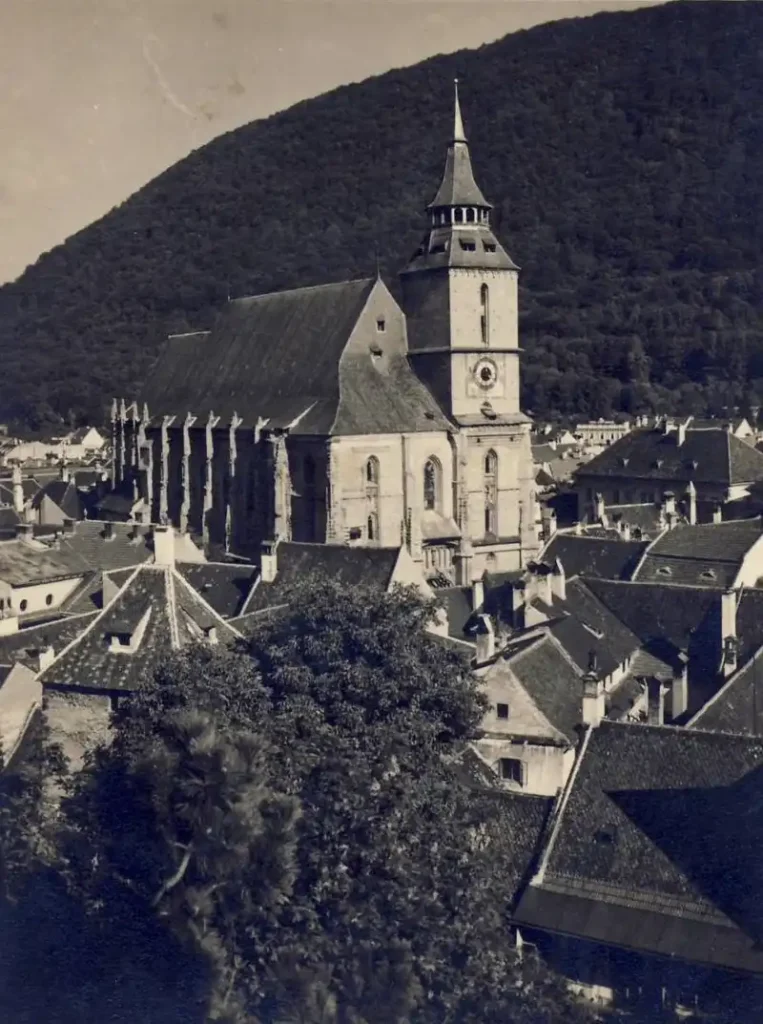
Black Church (Biserica Neagră)
Overview
As a painter slowly smears his paintbrush across a canvas, so have various kingdoms and factions flow across the Carpathian mountains and plains, leaving behind a brush stroke of ethnic diasporas struggling, surviving, and sometimes thriving in the Transylvanian plain.
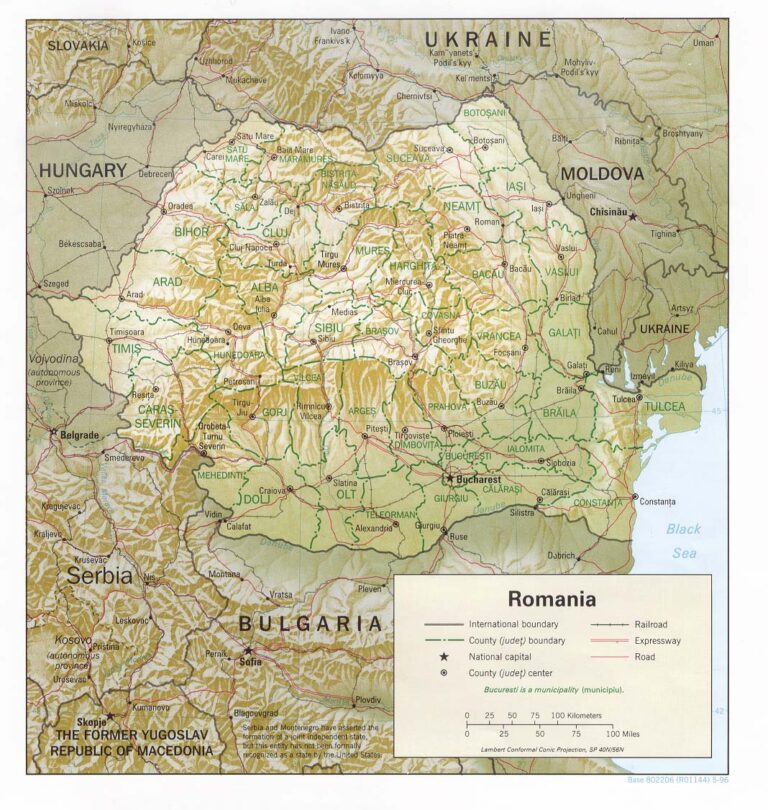
In this article, my focus is on the Saxon diaspora at the foothill of Mount Tâmpa. These are German families transplanted from the Hungarian empire during the 14th century.
Thanks to economic incentives passed by governmental decrees, trade routes were established through the mountains, turning a small village named Kronstadt (known today as Brasov) into a thriving city.
During this period, the Carpathians were the border not just between the political empires of Hungary and Wallachia, but the religious influences of Western Roman Catholicism and Eastern Greek Orthodox.
Construction and Early Ruin
Through the increase of trade, these Saxon merchants began plans for a Catholic Church as the epicenter for future Catholic support south across the mountain range.
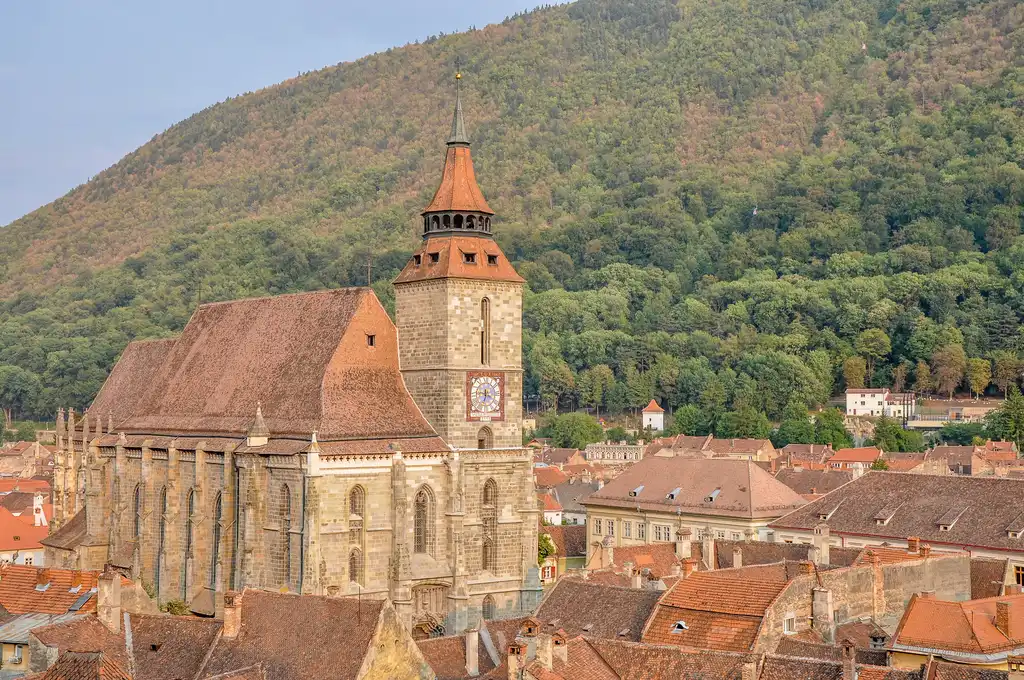
The design was heavily modeled after the raving trend of vaulted ceilings and pointed windows back in Germany. While gothic architecture had not yet breached eastward into Eastern Byzantine Europe, our Brasov Saxons were some of the first to bring the style across kingdom borders. Construction began in 1385 and took nearly 100 years to finish.

Floor plan of the Black Church in Brasov
Unfortunately, this period of prosperity would soon come to an end. South of the Carpathians, Prince Mircea the Old surrendered Wallachia to Sultan Mehmed I, becoming a tributary of the Ottoman Empire. The buffer that once lay between Hungary and the ambitious Turks was gone.
In 1421, the partially constructed church was destroyed by raiding Turks who descended from the mountains and sacked the prosperous city. With a defense budget skyrocketing into orbit, governmental expenses were unavailable to help the Saxons rebuild the church. Combined with the stolen assets of the Saxon merchants, reconstruction began with the original plans greatly reduced in size. Albert Weber, Historian at the Leibniz Institute for East and Southeast European Studies, attributes this financial reduction as the reason for a disproportionately large chancel compared to the present small nave.
Protestant Reformation
Construction on what was known as St. Mary’s Church completed during the late 15th century. For families across three generations, it remained Catholic. But the German influence didn’t end with the architecture. While Western traditions, architecture, and religions of Rome, France, and England took several decades to reach Eastern European countries, the tight bonds of communication between Germany and its enclave in Kronstadt allowed these cultural normatives to quickly soak in and disperse from the city. Thus, when Martin Luther began the Protestant Reformation in 1517, it took just over 30 years before the church community converted to Lutheran, largely due to one man: Johannes Honterus.
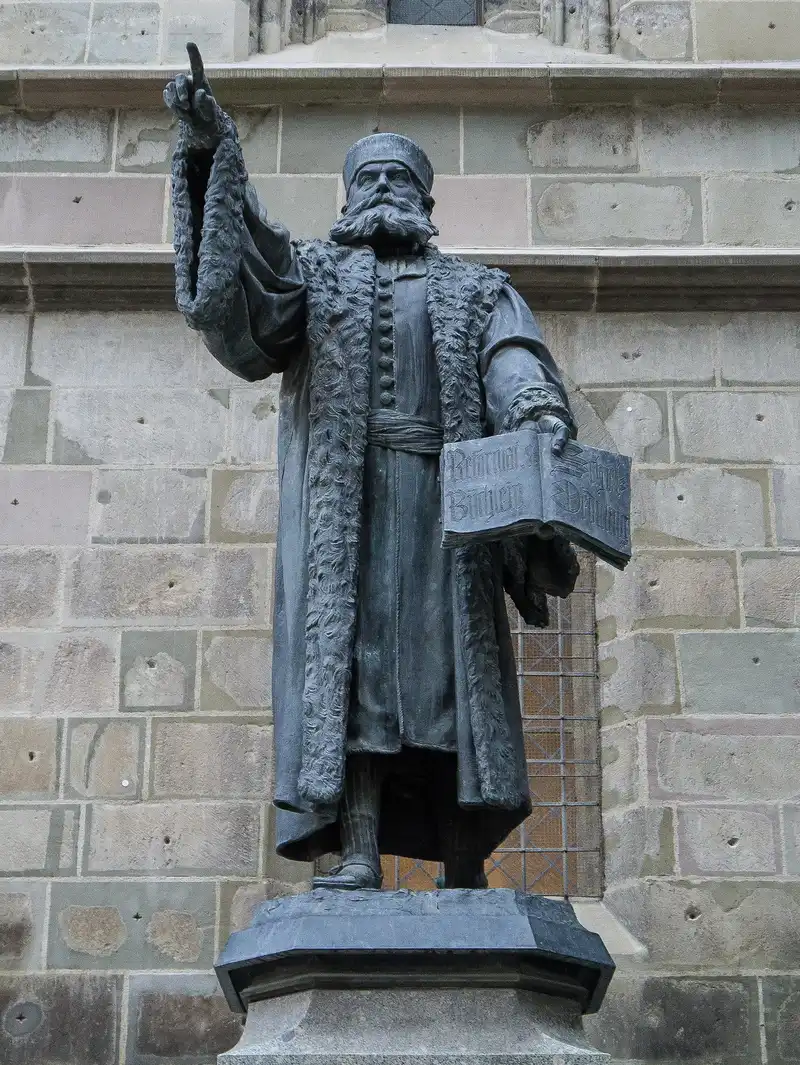
Nicknamed “the Luther of Transylvania”, he was an ambitious humanist known for his cartography, reformed writings, and educational pioneership of the Transylvanian region. In Brasov, he founded a printing press, paper mills, a public school, and a library, leading the city to become the forefront in education and economy.
Combining Johannes teachings on Reformed theology with the defeat of Hungary to the Ottomans, the mid-16th century saw the community quickly convert from Catholicism to Lutheranism, reorganizing the church to match the respective religious requirements. Iconoclasts cleared out the sanctuary of distracting visuals, including an impressive mural that stretched across the interior walls. Instead, these religious works were replaced with a large collection of Turkish carpets and decorative protestant pews to the satisfactory of the city’s prosperous guildsmen and parishioners. From this point on, the church remains protestant to the present day, but the building itself, did not.
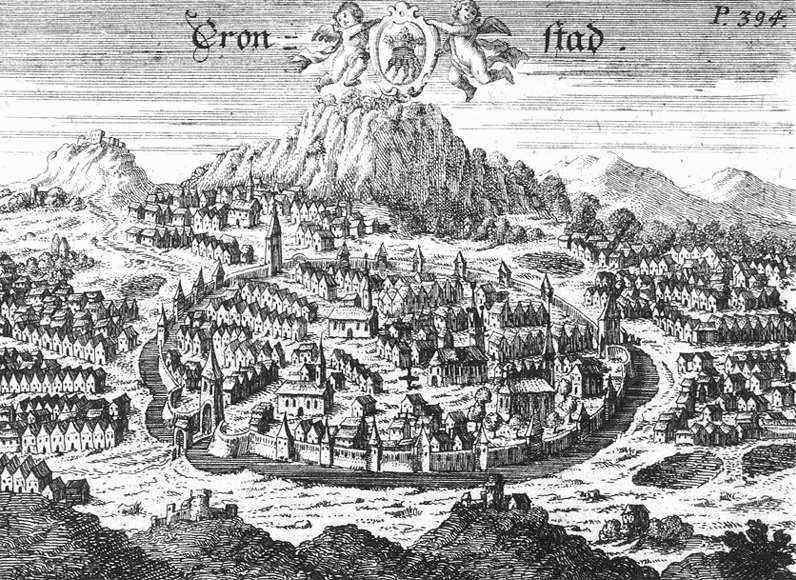
Johann Tröster, (1666) Das Alt und Neu Teutsche Dacia
It was April 21, 1689 when calamity struck. Legend or truth, the tension between religions exceeded normal temperatures, and a group of zealous Catholics laid fire to Kronstadt, burning the great church to ash. Was this an attack on religious freedom, or just another natural disaster on a vulnerable village of wood? I will let the reader decide.
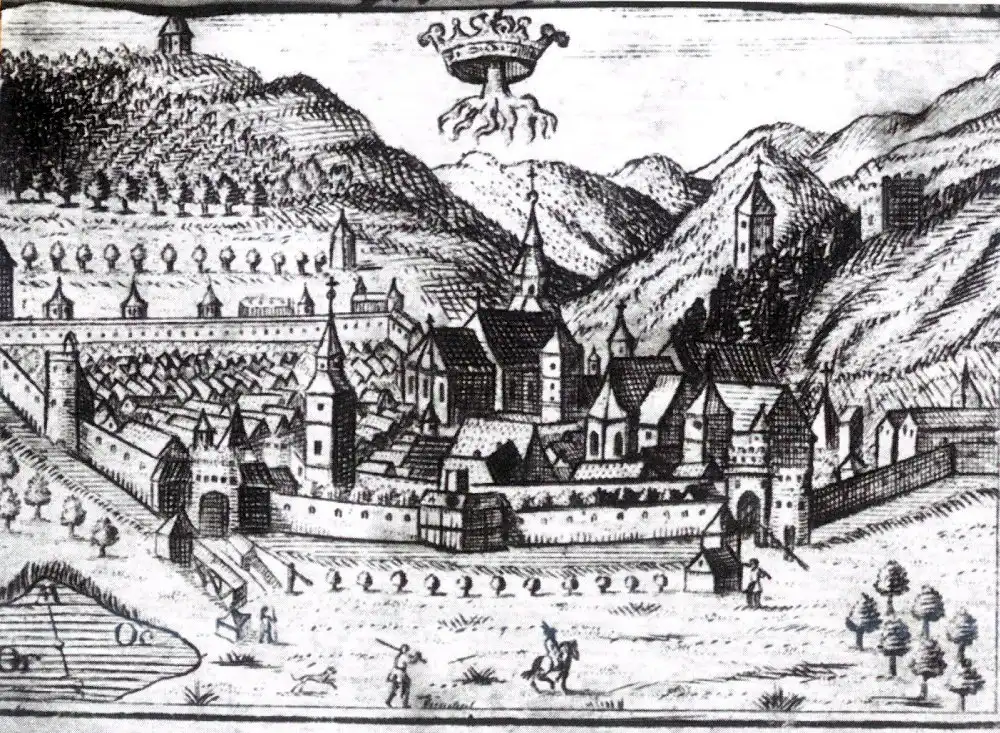
The fortress of Brașov in 1750. Note the crown with roots, based on the legend of King Solomon of Hungary and used in the present day city flag.
Architectural Details
A respective 100 years elapsed before re- reconstruction was complete. The church was reduced even further from the building’s majestic vision laid out pre- Turkish invasion. In Kronstadt, guilds never recovered from the many calamities, and the once prosperous merchants closed their mills and moved on, leaving minimal funds to support the restoration fund.
YouTube
Biserica Negră și Piața Sfatului! (Romanian)
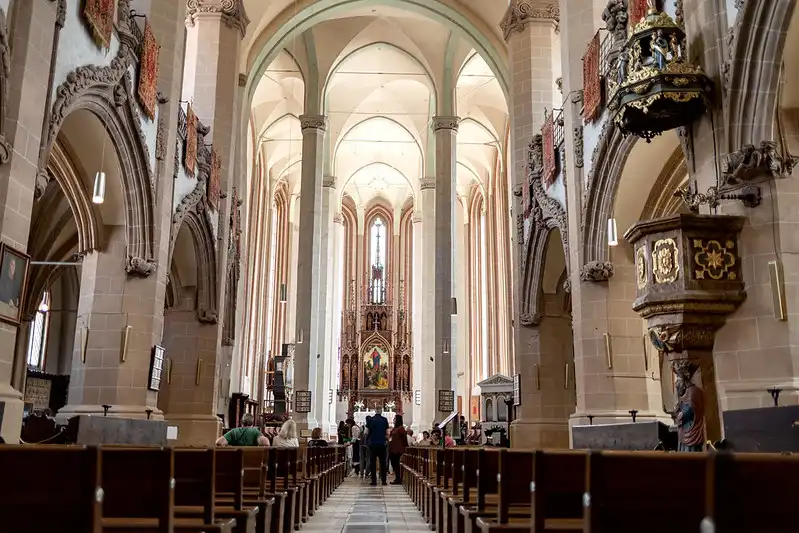
Despite this, several projects were donated by individual church members before the local economy reduced. The gothic architecture hides from a brief view through the incorporation of local styles from the local late Byzantine era, including red rigid roof tops and a solid brick steeple.
Considering the various calamities burdening the churches construction, can you blame the villagers for choosing a stronger design over paper-thin flying buttresses, exotic gargoyles, and hollow arches?
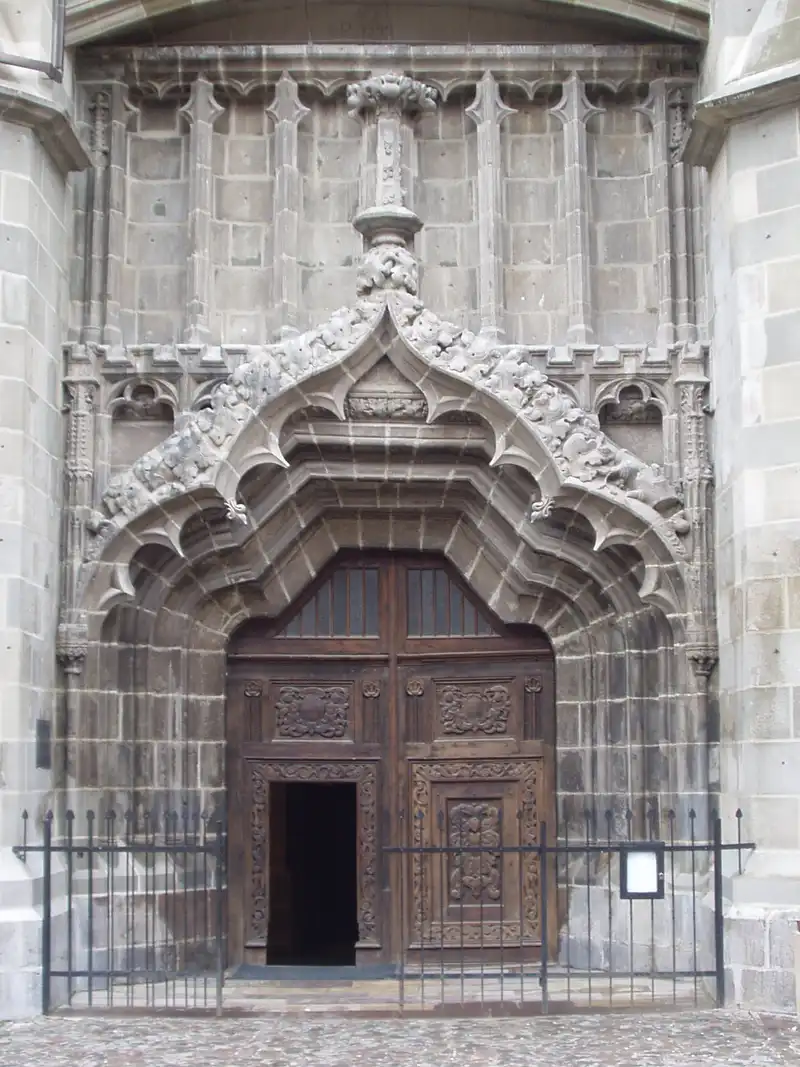
West Entrance (Pschemp – Wikipedia)
Gothic terminology can be found in the smaller details, such as pointed windows, vaulted ribbed ceilings, and a highly decorated western gate, with floral patterns, and geometric parabolas that cause the stone to swirl and float before your eyes.
The bare walls and columns inside the church are stark contrast against the individual items provided by the congregants. These liturgical objects demonstrate not just gothic furnishings, but also Baroque?!
- 1472 baptismal chalice with gothic triquetra ornamentation.
- 1665 pulpit with solid shapes, earthy tones with turquoise spindle caps.
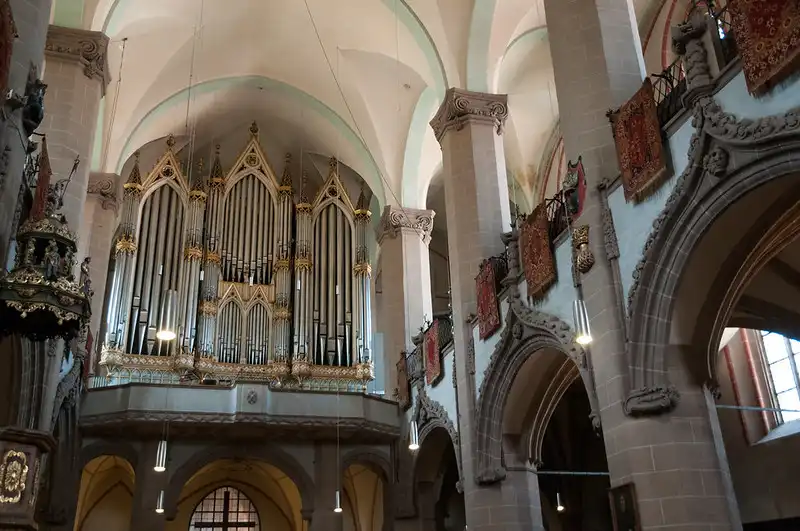
- 1836-1839 organ with neo-gothic asps and gold ornamentation, heavily influenced by baroque plasticity.
- 1866 alter with exaggerated height to width gothic proportions and ornamentalism.
This rhythmic pattern of governmental programs, incremental progress, then sudden absence of financial backing continued through the next couple of centuries. At the beginning of the 20th century, restoration was again approved and subsequently halted by the explosion of WWI. It resumed again under Communist rule, but halted in 1977 when an earthquake diverted state funds to country-wide repairs on infrastructure and humanitarian aid.
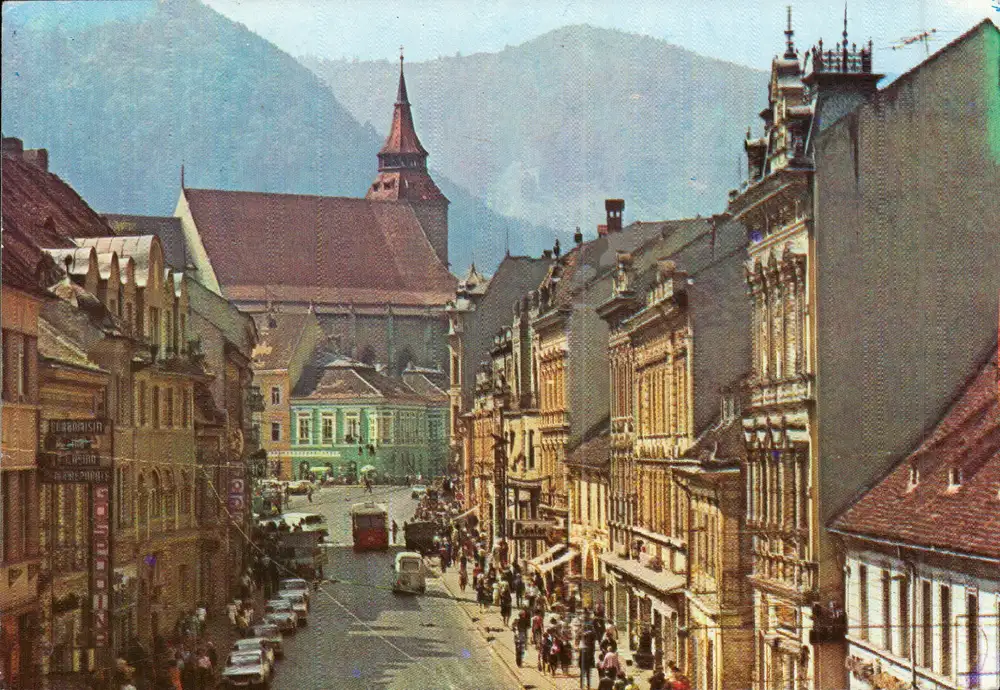
Brașov 1990 – strada Mureșenilor — Cartipostale
Communist Romania
During this communist anti-religion regime of Nicolae Ceausescu, the church and its congregants were severely repressed for their anti-establishment lifestyles and communications with Christians outside the country, mostly in Germany. And yet, funding for the church was still provided by the state, even enough for restoration work to occur. Why?
A reasonable explanation for this obvious "swan among chickens" is the tourism value Brasov and the church provided for the regime.
As a small minority, the protestant congregation could easily be overlooked when laid to scale alongside the secular financial incentive the governmental officials received.
Conclusion
Today, the church is managed under the Transylvanian Saxon community and confession, who led restoration efforts on several structures in Kronstadt (better known by its Romanin name Brasov). As you walk around the church grounds and gave up at the vaulted ceiling inside the nave, you will find many fabulous relics of craftsmanship relating to various points of the church’s history. But what the church is well known for, is at the base of its exterior walls; burnt black from a raging fire 400 years ago, yet symbolic as the Romanian Saxon’s resilience through opposing forces, and inspiration behind a globally recognized title as the Black Church (Biserica Neagră) of Brasov, Romania.
References
Weber, Albert, Die “Schwarze Kirche” in Kronstadt, Religiöse Erinnerungsorte in Ostmitteleuropa, Berlin 2013, pp 741-751
Johann Honterus. (2026). Itc-Cluj.ro.
Marcu Istrate, D., & Diana, A. (2017). The Black Church Cemetery: Interdisciplinary approaches to the study of a medieval urban skeletal assemblage (Braşov, Romania). Studies in Digital Heritage, 1(2), 364–379.